The Centre for Fortean Zoology was founded in the UK in 1992 - nearly 20 years ago. Over the past two decades it has expanded to become a truly global organisation. We opened our American office in 2001, or Australian office in 2009, and now - in our 19th year - we are proud to welcome CFZ New Zealand to the CFZ global family.
Showing posts with label nz. Show all posts
Friday, 10 May 2013
'Globster' starts whale of a sea monster tale
This bizarre-looking 9m-long corpse washed ashore last week in New Zealand, fuelling speculation that it is the remains of a prehistoric sea monster washed up ashore from the deep.
This latest “monster” carcass is the latest in a long line of discoveries of bizarre, rotting corpses mistakenly identified as sea monsters or dinosaurs, or even just mysterious “blobsters”.
Marine mammal expert Anton Van Heldon examined the latest ‘monster’ carcass in New Zealand and believes it is a killer whale, based on the fin structure. Killer whales, or orcas, are sometimes spotted in the Bay of Plenty.
Labels:
bay of plenty,
globster,
killer whale,
new zealand,
nz,
sea monster
Friday, 26 April 2013
Hunt resumes for Fjordland Moose
Moose hunter Ken Tustin is about to use updated technology in his bid to capture evidence of the fabled Fiordland moose, despite growing feelings the search may be in vain.
The 67-year-old biologist began putting cameras in the bush in 1994 in the hope of photographing descendants of the North American moose released in Fiordland in 1910.
Cameras were last installed in 2008, when 13 motion-sensor digital cameras with infrared flash were set up on animal trails near Herrick Creek and Henry Burn, near Dusky Sound.
The cameras were now "well past their use-by date" and needed to be replaced, he said.
But nearly 20 years after installing the first cameras, Mr Tustin said he was beginning to doubt whether the project was worth continuing.
"The job is getting harder and harder because there is quite a build-up of deer in Fiordland now and the forest is opening up, which creates more trails to choose from.
"It's becoming harder to know where to put the cameras. Sometimes it's difficult enough to decide which side of a tree to put one on.
"I was tempted to flag the mission, but we know far too much about the animal and the use of cameras to give it away so easily."
He said his main motivation for continuing was the addictive thrill of the chase and the fear of regret.
"I'd hate to end up in an old folks' home thinking, 'Gosh, if only we had just done it for one more season'.
"You get the feeling that the next time you go, that it will be the time you get the frame. It would be a shame to give it away now."
Mr Tustin said he had received sponsorship to buy new cameras, BF-7s made by Canadian manufacturer Spypoint, which are much more compact and durable.
The cameras were powered by six AA batteries, provided better-quality digital photographs, could hold more photographs and had a better trigger distance, he said.
"They also have black flash which is invisible - the animals won't even know they've been photographed."
He hoped to install them early next month, again on animal trails.
The last known photographs of moose in Fiordland were taken by Fred Stewardson, of Hikurangi, who took the pictures on a hunting trip to Wet Jacket Arm in 1953.
His older hunting companion, friend and mentor Eddie Young, swore him to secrecy for many years, fearing the moose would be shot by hunters if the photographs were revealed at the time.
Only a handful of photographs of moose in Fiordland are known to exist, most taken between 1923 and 1952.
Labels:
fiordland,
ken tustin,
moose,
new zealand,
nz,
oopa,
out of place animal
Friday, 4 January 2013
How the Takahe made a Lazarus-like comeback
A 'Lazarus species' is one that is presumed to be extinct and then reappears.
One such example is the Takahē, thought to have died out by 1898.
The bird was rediscovered in 1948 by Dr. Geoffrey Orbell, who wrote this article, which was originally published in the December 10, 1948 edition of the Listener, and recently re-published on its website.
Dr Geoffrey Orbell wrote:
My interest in the notornis (takahē) began some 30 years ago. I was looking through some old photographs belonging to my mother – a keen amateur photographer – when I came upon a print of a bird in a glass case. My mother explained that it was a picture of the notornis specimen in the Otago Museum, that only four of the species had been found and that it was now supposed to be extinct. That word “supposed” stimulated my boyish sense of adventure, and I read all that I could find about the notornis.
As I grew older the call of the outdoors became stronger and stronger. Deer stalking and pig hunting expeditions were frequent. They led me to Beaumont in the Blue Mountains in Otago, where I met Norman Murrell, the State Forest Warden. Mr. Murrell was born and brought up at Lake Manapouri on the fringe of the notornis area, and he heard stories of calls heard in the bush and of blurred tracks on sandy beaches. Once again I turned to Buller and Oliver’s books.
In 1929 while on an expedition after wapiti up the north arm of Lake Te Anau I kept a sharp look-out for all bird tracks, but only found those of weka or kiwi. On this trip I made the acquaintance of Charles Evans, then ranger to the Southland Acclimatisation Society. He told a tale of tracks he had seen on a beach in Dusky Sound; of a whole boat’s crew dashing here and there on the beach trying to catch a bird the size of a goose, a bird with blue-green feathers and with the speed of a racehorse. And he told of tracks in the snow-grass and droppings too big for any bird he knew.
From hearsay, and from stories told round campfires while stags roared challenges across high valleys, I picked up little bits of information. Then in 1935 I came to live and practise in Southland – and Te Anau was a near hunting ground. Ward Beer, another acclimatisation society ranger, told me of a large blue bird seen on the shores of Lake Ada which he thought might be a pukeko; and from a patient who once lived at Martin’s Bay came the story of a large blue bird seen on the beach there.
BASE AT LAKE TE ANAU
In 1945 I built a summer house at Lake Te Anau and later on, in partnership with Dr. D.R. Jennings, a 39-foot launch (I wanted to call it “Notornis” or “Takahe” because, as I stated then, I hoped to find the birds some day, but the vote of the families was against the idea, and the launch was christened “Takitumu” after the Maori canoe.) Maps have always interested me and the map of Fiordland was now of particular interest. On wet days and long evenings I would study it on the wall of the house at Te Anau.
Notornis? the question was always there, but rarely spoken of, and then only jokingly or as a bait thrown to catch some story. One man who knew Fiordland very well volunteered the information that in one certain area which he would not name, he always carried a hard-nosed bullet in his rifle – the bullet might be worth four or five hundred pounds, he said. But that was just another link in the chain. Studying the map and thinking of the birds, certain facts became clear in my mind. The stories were similar in one respect: all the birds were seen or caught on the beaches below the bush line. And as far as could be ascertained from Buller and from many other reports, all these birds were seen or taken in wintertime, and in years of very heavy snowfall.
UNKNOWN COUNTRY
By plotting all references to the bird on the map it became apparent that there was a vast area of Fiordland surrounded by reported instances of notornis being found or seen – and that piece of country was the least exlored of the whole Fiordland National Park. I heard stories of a large lake seen from the air, and Maori history suggested its existence and also its whereabouts. Deer might be there and as president of the New Zealand Deerstalkers’ Association I had an interest in them too, but the fact remained for the most part that notornis were seen or captured only at low levels in hard winters.
We first went into that country on April 11 of this year (1948), the party consisting of Rex Watson, Neil McCrostie and myself. It was very tough going and took over four hours’ climbing to get to the top. Finally we topped a ridge and suddenly found ourselves on the edge of a terrific precipice. Far below us a large lake glistened in the sun, and a valley filled with snowgrass extended three miles beyond it. Through the glasses I sighted a young stag almost directly below us, but the cliffs were so high that he could only just be seen with the naked eye.
We scrambled round great overhanging bluffs and rocks and eventually managed to find a route by which we literally slid and scrambled down to the valley floor, where the billy was boiled and we separated to stalk roaring stags. I shot a poor fourteen-pointer and sat down to wait for the others.
THE CALL OF THE TAKAHE
I was then almost halfway up the valley above the lake and dozing in the snowgrass, when I heard a bird call which I did not recognise – two very long, deep notes repeated twice. I was very tired and I sat and wondered about them. When Rex and Neil returned both accused me of whistling to them over a .303 cartridge case. It was then mid-afternoon and I was in no frame of mind to investigate noises and run the risk of being benighted in the bush. Rather than attempt the awful climb out of the valley we decided to push on and try and get out by way of the gorge below the lake. And on a beach at the bottom end of the lake we found fresh bird tracks large enough for us to be quite certain that they were the tracks I had dreamed about. The sun was already sinking behind the mountains, and we had to hurry to get down through 2,000 feet of bush before dark, so I measured the tracks as carefully as possible by scratching marks on the stem of my pipe – which is practically always in my mouth and therefore less likely to be lost.
On our arrival in Invercargill the measurements were quickly put on paper and sent to Professor B.J. Marples, at Otago University. At the same time I compared a duplicate set with all the published evidence available. They matched Buller’s measurements fairly closely and the Rev. C.J. Tocker, who is a keen ornithologist, agreed that they could only be those of a nortonis.
Professor Marples, however, was of the opinion that the tracks were too big for a notornis and were probably those of a white heron. Dr. R.A. Falla, of the Dominion Museum, was the next to see the diagram, but he could not reconcile it with any known bird tracks.
When all this news came back, my two friends, Rex and Neil, were very despondent because they were all keyed up for a discovery. The news, however, did not worry me, for I realised that, to a man experienced in reading nature signs, a line of fresh tracks on a beach was of far more value than a diagram on a piece of paper could be to the authorities. I had in addition the added knowledge that the Otago Museum specimen was a young female and suspected that I had seen the tracks of an adult male; and so it was proved.
THE SUCCESSFUL EXPEDITION
On November 20, 1948, we once more made the arduous climb back to the valley and on this occasion we were accompanied by Miss J.L. Telfer. This time the only equipment carried comprised cameras and 50 yards of fishing net, which I figured was the best means of attaining our object. Not 20 yards from the the beach where we had seen the tracks I saw the first notornis and my first reaction was to think what a small bird it was. Thereafter our plan of action moved steadily to its successful conclusion.
First I took a full reel of colour movie film through the telephoto lens. Then the arrival of the second bird on the scene caused me to take another half reel from a distance of 20 yards. When I stood up the birds were no more perturbed than farmyard hens and only moved a few feet into the snowgrass where the net was quietly circled round them. They walked into it of their own accord. Handling them as gently as possible, we took them to the beach, where they were securely tethered by one leg, photographed, and then released as quickly as possible to the nest which all the signs indicated was near by. The nest, I decided, must be left for another year rather than keep the hen too long from the eggs, or run the risk of driving her away from the nest completely. A third bird was chased half-heartedly towards the bush, where in full view he fed and squawked for nearly an hour.
Once having seen notornis sign, nobody with any tracking ability could ever mistake it for anything else and at a later date I hope to be able to untangle the skein of stories about notornis, and show why it has not been seen for 50 years. It has not been because it was not there – it has just been because no one knew just where to look.
Click on the image below to watch an episode of the NFU’s Weekly Review newsreel series treks from Lake Te Anau high into the Murchison Mountains, where the team (including naturalist Robert Falla) find sea shell fossils, evidence of moa-hunter campsites, and the dodo-like takahē itself.
Labels:
extinct,
lazarus species,
new zealand,
nz,
takahe,
the listener
Saturday, 17 November 2012
Dreaming of Moas
Strange stories of strange birds and even stranger fossils were coming from the end of the world during the 19th century.
The first Europeans spotted New Zealand in 1769 and Captain Cook explored the Northern Island four years later. Cook was very interested in natural history and collected tales about the fauna and flora from the locals.
On the Northern Island nothing unusual was reported, however on the Southern Island legends involving a monstrous bird existed. These legends explain an unusual hunting method for a large bird. Hunters would use incandescent rocks, which swallowed by the bird would then burn it from inside. The preferred habitat of these birds was said to be the swamps and forests and according to some legends until 1800 they were very rare animals, but still living on the island.
In the year 1823 a hunter named Meurat claimed to have found a bone with flesh attached to it. He assumed by the apparent good preservation that the remains were very recent.
Joel Polack, a trader who lived along the eastern coast of the Northern Island, records that during a forced stop of his ship in the Tolaga Bay in 1838 he had been shown “several large fossil ossifications” found near Mount Hikurangi by the Maori in the winter of 1834. He was certain that these were the bones of a species of emu or ostrich, adding in his report that “the Natives add that in times long past they received the traditions that very large birds had existed, but the scarcity of animal food, as well as the easy method of entrapping them, has caused their extermination“. Polack further noted that he had received reports from Maori that a “species of Struthio” still existed in remote parts of the Southern Island.
The German naturalist and geologist Ernst Dieffenbach also refers to a fossil from the area near Mt. Hikurangi and reports that it belongs to “a bird, now extinct, called Moa* (or Movie**) by the natives”. He continues “On questioning the natives, as I usually did, relative to the natural history of their country, I heard a curious tradition connected with the totara-tree in the neighbourhood. Near this tree they said their forefathers killed the last moa. From the few remains of the moa that have been found it has been declared by Mr. Richard Owen to be a struthious bird of large size."
Read the whole fascinating piece by David Bressan over at his Scientific American blog. You'll be surprised where this story ends up!
Labels:
moa,
moa bone,
moa searching committee,
new zealand,
nz
Thursday, 9 August 2012
OOPA: Moose photos from Canada, not NZ
Four photographs of three moose that a Northland man claimed last year were taken in Fiordland in 1953 were actually taken in Canada.
In June last year, the late Fred Stewardson, of Hikurangi, recounted to the Otago Daily Times and other media how he and a companion came across the animals on a hunting trip to Wet Jacket Arm.
However, Fiordland moose researcher Ken Tustin, of Bull Creek near Milton, said yesterday after two years of work he had established the photographs were taken near Banff in 1958.
Mr Tustin was uncertain of Mr Stewardson's motives but had found Mr Stewardson's life was "full of exaggerations".
"The old fellow was absolutely entranced by the moose story, knew or found out, through me, a bit about it, and then wrote himself into it."
Mr Tustin received final confirmation Mr Stewardson's story was false by speaking to his ex- wife in Australia, who clearly recalled where the moose photographs were taken.
Mr Tustin said he had spent hours speaking to Mr Stewardson by phone and had received letters from him supporting his story.
He now believes Mr Stewardson, who died nine months ago, never visited Wet Jacket Arm but was quite likely in Fiordland in 1952 when the head of a bull moose was brought out of the bush.
North American moose were released in Fiordland in 1910 and Mr Tustin has spent many years trying to establish that their descendants remain there.
Mr Stewardson claimed he kept the photographs a secret for 60 years to keep the Fiordland moose safe from other hunters.
"Fiordland will have loads of trigger-happy clowns there for slaughter.
Many won't give a damn if moose survive or not," he wrote to Mr Tustin last year.
Mr Tustin said he had early reservations about the photographs because of the shape of vegetation, but believed it did resemble vegetation he had seen in different parts of Fiordland.
After the photographs were published in the ODT he received an anonymous call warning him not to believe Mr Stewardson.
But despite offering Mr Stewardson the opportunity to retract his story, he never did.
"I'm disappointed he carried his story - knowing it was not true - to such great lengths ... knowing how important the accuracy of my [moose] history was to me."
Labels:
canada,
fiordland,
ken tustin,
moose,
new zealand,
nz,
oopa,
out of place animal
Monday, 16 April 2012
Flight of a Kakapos key to survival
The transfer of seven critically endangered kakapo to Little Barrier Island is a significant move to help secure the species’ survival, Conservation Minister Kate Wilkinson says.
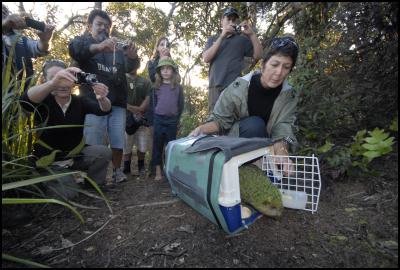
The native parrots were captured on the predator-free Whenua Hou/Codfish Island and Anchor Island in Southland then airlifted – by helicopter and Air New Zealand passenger flights - to their new home north of Auckland yesterday.
Though the birds will be monitored by the Department of Conservation on Hauturu/Little Barrier Island, they will be free to breed and raise their chicks without the high level of support they currently receive.
“This is an epic journey by these flightless birds. They have been flown almost the length of the country in one day to a new home,” Ms Wilkinson says.
“The kakapo have been released on Little Barrier Island to see if they can successfully raise their chicks without aid. Their progress will be closely monitored and support will be provided if it’s required to keep the birds alive.
“There are only 126 kakapo left in the world and we need to see if they can survive and flourish without outside help. This initiative could play a major role in securing the long term survival of the species.
Kakapo lived on Hauturu/Little Barrier Island between 1982 and 1999, when they were moved so the island could be cleared of rats. It is expected to take up to 10 years to determine if the kakapo can bring up their chicks without assistance.
The work is part of the Kakapo Recovery Programme, a joint initiative between the Department of Conservation, New Zealand Aluminium Smelters and Forest & Bird that dates from 1990.
“This is DOC’s longest-running conservation partnership and it’s been a great success. Since it was formed kakapo numbers have more than doubled.
“This partnership shows what can be achieved when the government, the private sector and the community work together toward a shared conservation goal.”
Background Information:
The kakapo or ‘night parrot’ is unique to New Zealand and was pushed toward extinction by human colonisation and the introduction of predators such as rats, stoats and possums. By 1995 only 50 kakapo were known to exist. Today there are 126 kakapo being managed by DOC on Whenua Hou/Codfish Island, near Stewart Island, and Anchor Island, in Fiordland.
The Kakapo Recovery Programme includes running breeding programmes, maintaining predator-proof sanctuaries and strengthening the wild kakapo population. It combines the efforts of scientists, rangers and volunteers. This work includes intensive monitoring of kakapo, regular health checks, predator control, supplementary feeding, artificial incubation and hand-rearing, research (ground breaking artificial insemination in birds, genetic studies, and supplementary feeding trials), and developing technology.
Eight kakapo were captured on Whenua Hou/Codfish Island and Anchor Island yesterday. One of the birds was found to have a minor injury and was taken to Auckland Zoo as a precaution.
Labels:
kakapo,
kakapo recovery programme,
new zealand,
nz
Thursday, 8 March 2012
Search is on for NZ's last Kakapos
They are calling it the search for the last kakapo, according to Fairfax newspapers.
A Conservation Department (DOC) team flew to Fiordland - the endangered birds' last mainland stronghold - in the hope of finding evidence of their existence in historic breeding areas.
The trip was sparked by a credible-sounding report from trampers that the ground-dwelling parrot's distinctive "booming", or mating call, was heard in the remote Transit Valley, near Milford Sound, on New Year's Day.
If audio recorders left on the valley's rugged ridgelines pick up further booming, it will be the first confirmed sign of kakapo on mainland New Zealand for decades.
Kakapo Recovery Programme manager Deidre Vercoe Scott said the mission was a long shot, but the discovery of new birds would be significant for the population's recovery.
Once threatened with extinction by stoats, ferrets, weasels and cats, the kakapo is now threatened by poor genetics.
All but three of the remaining 126 birds, living on two predator-free islands, originate solely from Stewart Island stock.
Scientists believe that genetic bottleneck has led to complications with the breeding programme, including high levels of infertility and embryo death.
Concerns about poor genetics has prompted DOC to consider removing one bird, Basil, from the breeding programme after the death of four of his young progeny since 2004, including one young male that died last week.
Southland-based DOC technical support manager Andy Cox, whose first kakapo-related trip to the Transit Valley was in 1976, said finding birds with Fiordland DNA was potentially valuable.
"This report sounds particularly hopeful and we've just got to keep our fingers crossed," he said.
Kakapo can live for 90 years, and some Fiordland kakapo fitted with radio transmitters in the 1980s have never been found. A DOC-led search in Fiordland in 2006 proved fruitless.
Last week, Vercoe Scott's team spent four nights camped on the eastern side of Transit Valley in an area known as "kakapo castle". The trip was funded by the Christchurch-based Mohua Charitable Trust.
The team set up audio recorders and checked known breeding sites.
Vercoe Scott said there were no fresh signs of kakapo.
"I think it's quite unlikely that we'll discover anything this year, but we'll earmark that area for the next breeding season and return those recorders just to make sure," she said.
DOC intends to retrieve the recorders within two weeks.
The species seemed doomed until the discovery of about 200 kakapo on Stewart Island in 1977. However, numbers continued to drop, hitting a low of 51 in 1995.
Labels:
kakapo,
new zealand,
nz
Wednesday, 9 November 2011
Sirocco is one in 129 (Kakapos, that is)
He's one of the most popular birds in New Zealand, and as one of just 129 endangered Kakapos in existence, one of the few night parrots left, making him very special indeed.
Sirocco shot to international fame after getting frisky with British celebrity Stephen Fry and zoologist Mark Carwadine in the acclaimed TV series Last Chance to See in 2009. Sirocco found Carwadine's hair inexplicably attractive, prompting Fry to exclaim: "You are being shagged by a rare parrot!"
Bizarrely, bidders on Trade Me recently clamoured to buy a unique piece of Sirocco-related history - his rejected 'pine chews' being sold on the popular online auction site. The 'parrot puke' eventually fetched $400!
The posting stated: "Not to be found anywhere else on the Mainland - this is a truly unique item. Impress your friends. Perturb your mother in law. Made of tenderly masticated pine needle and infused with the saliva of an extremely rare native parrot - and not just any old rare native parrot but Sirocco the famous head shagging parrot!"
Well, there you go. It was all for a good cause though - the money will be used to fund kakapo recovery.
For those who can't meet Sirocco in the flesh and feathers, you can watch him on this video:
Labels:
kakapo,
last chance to see,
mark carwadine,
night parrot,
nz,
sirocco,
stephen fry
Monday, 8 August 2011
Fish discovery off nearby Kermadec Islands
![]() |
| D brachypterus - Shortfin lionfish, first recorded from the Kermadec Islands (and New Zealand) in 2004. |
Three fish new to science are among those discovered by an Australian and New Zealand research team which returned recently from a successful expedition to the volcanic Kermadec Islands, 1000km northeast of New Zealand.
The three new species include a bright orange lotella cod; an ‘orange spot’ pipefish; and, a left-eyed flounder – all of which are just 10 cm long.
Three Australian Museum marine scientists are amongst the team which also recorded 12 species of fish that have never been documented anywhere in the New Zealand region before, and collected a further five fish species that are new records for the remote Kermadec Islands – New Zealand’s largest marine reserve.
Dr Penny Berents, Head of Natural Science Collections at the Australian Museum, said Australian Museum scientists are also expected to identify new marine invertebrate species among the thousands of specimens they have collected.
“Expeditions such as this are vitally important for gathering research specimens and data to improve our understanding of marine biodiversity and provide critical information for understanding and predicting the effects of climate change,” said Dr Berents.
Expedition leader & former Australian Museum scientist, Dr Tom Trnski, now with Auckland Museum, said the expedition was a resounding success.
“We really feel we have been working at the frontiers of marine research, both physically in the sense of working somewhere so remote, and also biologically in the sense of making new discoveries,” he said.
“Every day was exhilarating, as we never knew what we might find.”
While formal identifications will take many months, some of the creatures collected – such as the mysterious sea hares - have already created much interest.
Sea hares get the name ‘hare’ because - like rabbits - they are constantly munching their way through the small plants that grow on rocks.
Australian Museum Scientist, Dr Mandy Reid, said while most sea hares are generally no bigger than the palm of your hand, she found one that was the size of a football.
“They’re a real mystery because no one onboard the boat was a sea hare expert and we couldn’t find any of them in the books we had so we think they may well be a new species,” she said.
The research team - which included scientists from Auckland Museum, the Museum of New Zealand Te Papa Tongarewa, the Australian Museum, and the NZ Department of Conservation - collected more than 4300 specimens on the three week expedition.
The specimens have been readied for shipment to the three participating museums where work will now begin in confirming the identity of all the fish and invertebrate material collected. A final report confirming all the expedition’s findings will be published next year.
The Australian Museum’s participation in the Kermadec expedition was funded by the Australian Museum Foundation.
Labels:
discovered,
fish,
kermadec islands,
new zealand,
nz
Monday, 25 July 2011
Mythical monster puts NZ on notice
A mythical swamp monster "hiding" under Auckland is threatening to derail a project to improve the New Zealand city's traffic gridlock.
The North Island city is trying to move ahead with a multi-billion railway tunnel project to improve the minimal train network and free up its car-filled streets.
But Horotiu, a mythical monster, put the NZ$2.6bn ($2.1bn) project in doubt after an indigenous Maori board protested that it will destroy grounds once patrolled by the taniwha (pronounced "tani-fa").
Glenn Wilcox, a member of the Maori Statutory Board, which protects Maori interests, complained that the plan did not take into account the monster, which "was here first".
"As kaitiaki, or guardians, they protect people, but they also get up and bite you if they do not like what you are doing," he said.
The local council has since convinced the board that the correct consultation had taken place, putting the popular project back on the table.
The board accepted its needs had been met but not before it was invoiced thousands of dollars for public relations advice relating to the monster.
The monster now appears to have opened a Twitter account, @TaniwhaHorotiu, where it claims: "If I get my asking price I've got my eye on a stream out near Waterview."
It claims taniwha aren't invincible; in fact, one dies "every time a child reads a science book".
Surprisingly, its not the first time a taniwha has threatened to up-end a council project.
In 2002, construction of a stretch of road between Auckland and Hamilton was halted after protesters complained that it was cutting through the domain of a revered one-eye taniwha.
The taniwha was thought to be responsible for a number of deaths on the stretch of road.
Ranginui Walker, a respected Maori elder, said at the time: "You have to placate local demons, deities, taniwha.
"Don't tempt fate."
Labels:
horotiu,
new zealand,
nz,
taniwha
Wednesday, 20 July 2011
Rare Takahe birds the focus of fundraising drive
These rare flightless birds of a feather need to flock together to keep their species afloat.
There are only 220 Takahe left in New Zealand and about 30 have been treated at the New Zealand Wildlife Health Centre at Massey University.
And three of the birds were the focus of a sponsorship drive recently run by the Centre at the Tiritea School. Sadly one of the birds had to be put down due to a severe leg injury.
The Takahē or South Island Takahē, Porphyrio hochstetteri is a flightless bird indigenous to New Zealand and belonging to the rail family.
It was thought to be extinct after the last four known specimens were taken in 1898. However, after a carefully planned search effort the bird was rediscovered by Geoffrey Orbell near Lake Te Anau in the Murchison Mountains, South Island, on November 20, 1948.
Labels:
bird,
new zealand,
nz,
takahe
Friday, 8 July 2011
Endangered swamp bird Boris gets a second chance
A rare endangered native New Zealand wetlands bird has been brought back from the brink of death at Massey University's Wildlife Centre after arriving with a severely damaged wing.
Boris the New Zealand Matuku was picked up by Bird Rescue Whanganui and taken to the centre because of a fractured right wing which had led to it twisting around.
He was due for surgery on Tuesday but suffered a cardiac arrest after being anaesthetised and was resuscitated by veterinarians who decided to postpone the wing surgery.
Boris' wing fracture had healed out of alignment, so it would have to be rebroken and the muscles around it stretched out because they had contracted with the new position of the wing.
Matuku are endangered in both New Zealand and Australia.
There are about 750 left in New Zealand and less than 1000 in Australia.
There was great concern for the falling numbers of Makutu but it was difficult to learn about them because they were so good at existing unnoticed.
Massey University zoology lecturer Phil Battley said the main way the birds were monitored was by their loud booming calls. "They are a hard bird to get a handle on because they live in swamps."
Labels:
new zealand,
New Zealand Matuku,
nz
Wednesday, 6 July 2011
OOPA: Was Emperor Penguin colonising NZ?
Richard Sadleir, a former director of science and research for the NZ Conservation Department, has some interesting ideas on why the Emperor Penguin now known as 'Happy Feet' decided to up stumps and visit the land of the long white cloud. Here he writes for the Dominion Post about his theory:
"Why should an emperor penguin travel from distant Antarctica to finish up on a New Zealand beach? The distribution and movements of animals is a fascinating part of ecology. Most populations live in well defined ranges but, surprisingly, often individuals wander long distances from their normal home.
Happy Feet is the second emperor penguin in 40 years to reach New Zealand shores since naturalists started keeping records.
It is very likely that many emperors made it to New Zealand in the past 1000 years and many more would have travelled north and probably died before they could return home.
Why should this happen ? Ecologists think that the evolutionary reason for roaming animals, often called stragglers, is that, by chance they may arrive at a suitable place to live, then settle down and start a new colony, therefore extending the range.
A pregnant female mammal, or a female bird with an egg forming inside her, could theoretically start a new population, but in most cases more than one straggler would be necessary.
Almost all of these roaming individuals die but the process of such attempted dispersal continues as it has for thousands of years.
About 50 years ago a keen naturalist in New Plymouth kept a light trap running for many years. Insects attracted to the light are collected in a container.
The naturalist found hundreds of butterflies and moths that had blown over the Tasman Sea from Australia, especially after big storms. Almost all of these never established themselves here, probably because of our colder temperatures.
Again and again, special animals try the long trips to find new areas to live. Almost all die but some are successful.
In 1912, a small Australian wallaby was freed east of Rotorua. This species has very slowly increased its range eastward, getting halfway to Whakatane. But year after year, locals have reported seeing wallabies many kilometres away from the main range. These stragglers may find new habitats or they may not.
Three wallabies that turned up in Taranaki were certainly helped in their dispersal by a passing hunter!
The Indian mynah bird shows the same process. Introduced to the North Island in 1875, this bird, considered by many to be a pest, spread widely and now lives almost entirely north of a line from Whanganui to Waipukurau. It is apparently too cold for this species further south, yet there are sightings of stragglers trying to probe southward.
Strangely, the species was found in Wellington many years ago but it then vanished. Perhaps, as our climate warms, this unpleasant bird may make it south.
So Happy Feet is a sort of pioneer, looking for a new place to live. The penguin seems to have travelled too far in its quest but its relatives back in Antarctica will continue the process of travelling far from home to see if new homes are available.
Labels:
emperor penguin,
happy feet,
new zealand,
nz
Monday, 4 July 2011
Whales re-colonising NZ waters
Scientists have discovered that southern right whales, hunted to near extinction in the 19th century, appear to be re-colonising mainland New Zealand calving grounds from a remnant population in the subantarctic Auckland Islands.
The endangered whales were rarely seen around mainland New Zealand for most of the last century, but small and growing numbers are slowly returning to the coast to give birth and raise their calves.
“With the increase in numbers observed around the Auckland Islands over the last decade, we think that some individuals are re-discovering the former primary habitat around the mainland of New Zealand,” says Professor Scott Baker of The University of Auckland and Oregon State University, who helped initiate the first study of the Auckland Island population in 1995.
The latest findings are based on genetic evidence from small skin samples collected from 707 whales over more than a decade. By comparing the DNA fingerprints of individual whales, the research has confirmed genetic differences between whales around Australia and New Zealand, and provides new insight into differences in the recovery of regional populations.
The results support the conclusion that the mainland New Zealand population was wiped out and that the returning whales are from the remnant subantarctic population. It revealed, for the first time, the movement of seven individual whales between the Auckland Islands and mainland New Zealand. “The seven whales that have been identified in both the Auckland Islands and the mainland are probably the first pioneers of this re-colonisation,” says Dr Baker.
The research has been published today in the international journal, Marine Ecology Progress Series, by scientists from The University of Auckland, New Zealand Department of Conversation (DOC), Australian Antarctic Division, Macquarie University, the Museum of Western Australia and Oregon State University.
“The results confirm the strong connection of right whales to regional calving grounds around Australia and New Zealand as a result of early maternal experience,” says lead author Emma Carroll, a PhD student from The University of Auckland. “This maternal fidelity contributed to the vulnerability of these local populations, which were quickly hunted to extinction using only open boats and hand-held harpoons.”
Maternal fidelity is a kind of cultural heritage passed from a mother to calf during the first year of life, as they migrate together from calving grounds to feeding grounds thought to be near the subantarctic convergences.
When right whales around mainland New Zealand were wiped out, this heritage seemed to have been lost, slowing the return of whales to their former habitat. Surprisingly, a remnant population that calves in the subantarctic Auckland Islands survived and has shown signs of recovery, with surveys in the 1990s revealing an estimated 1,000 individuals.
With increased numbers of southern right whales returning to the mainland shores, DOC is calling on the public to report sightings of this rare whale. “With the winter calving season upon us, we are once again calling for the public to immediately report sightings of southern right whales to 0800 DOCHOT” says Dr Laura Boren, the DOC National Marine Mammal Coordinator.
DOC also has a flickr gallery where the public can upload images of the whales, at www.doc.govt.nz/marinemammalsightings. Dr Boren reminds photographers not to get too close to the whales, however. “To keep both you and the whale safe, leave a distance of 50m or 200m if there is a calf present,” she says.
The research article, entitled “Population structure and individual movement of southern right whales around New Zealand and Australia”, with the unique identifier “doi:10.3354/meps09145”, will be available for free download from the Marine Ecology Progress Series website www.int-res.com/journals/meps/
Southern right whales are large, long-lived mammals that calve in shallow coastal areas where they were hunted intensively in New Zealand and Australia in the 19th century. The species was given legal protection by the League of Nations in 1935 but was subject to illegal whaling in the 1950s and 1960s. The current New Zealand population is estimated to be less than 5 per cent of its pre-whaling abundance.
Labels:
auckland islands,
new zealand,
nz,
southern right whales
Friday, 1 July 2011
Great White Shark hauled from harbour
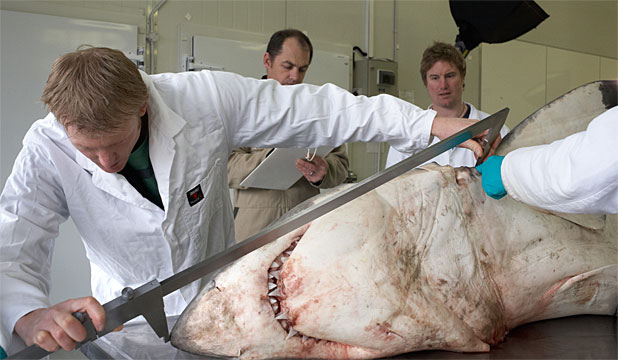
A 2.8-metre great white shark hauled out of the entrance to Wellington Harbour had been feeding on large marine mammals.
A team at Te Papa defrosted the shark, caught last year, for measuring this week. It was the largest great white specimen preserved intact in New Zealand, Te Papa collection manager Andrew Stewart said.
One of the biggest surprises, for the examiners, was discovering that the shark had an empty stomach except for a seal claw and some tape worms.
The claw was the "smoking gun" that it had started eating seals, he said. "This shark had moved from being a fish eater to being an apex predator ... These are animals that sit right at the top of the food pyramid."
Scientists would study markings to establish if the shark had been spotted off Stewart Island, where Conservation Department shark expert Clinton Duffy had collected photographic records of great whites.
Cells of the shark would be analysed to try to discover what else it had been eating.
The shark was hauled from the water near Barrett Reef in October last year by Peter Amitrano and Alfonso Basile, who had set moki nets.
Great whites are a protected species, meaning if they are caught, the Conservation Department has to be notified.
Labels:
great white,
new zealand,
nz,
shark
Thursday, 30 June 2011
OOPA: NZ moose photos revealed
Four photographs of moose taken by a hunter in Fiordland almost 60 years ago have finally been revealed publicly.
Fred Stewardson (78), of Hikurangi, in Northland, took the photographs on a hunting trip to Wet Jacket Arm in 1953.
But his older hunting companion, friend and mentor Eddie Young, swore him to secrecy, fearing the moose would be shot by hunters if the photographs were revealed at the time.
Only a handful of photographs of moose in Fiordland are known to exist, most taken between 1923 and 1952.
Mr Stewardson's photographs, taken from about 70m, include the only known photograph of a group of three moose - a bull, a cow and its calf.
Ken Tustin, of Bull Creek, near Milton, who has spent years searching for the descendants of the North American moose released in Fiordland in 1910, describes the rare photographs as "by far the best and most informative" he has seen.
He also regarded the history of the photographs as "quite an extraordinary moose story".
"Since we've been in touch, Fred has got such a kick out of our moose quest.
"He has rediscovered his own interest in moose and has gifted us the use of his photos.
"He now figures the secrecy agreement has been outlived and ... when he goes, he doesn't want the story and what he knows are very special pictures to go with him."
Mr Tustin said he learnt of the photographs too late for his 2010 book, A (Nearly) Complete History of the Moose in New Zealand.
"The photos would have transformed it."
Mr Stewardson, who was dairy farming at Kakanui in the 1950s, was always a keen hunter and photographer.
In letters to Mr Tustin, he recalled how he came across the moose and how he rushed to take the photographs with his Agfa Super Silette and telephoto lens.
"It's just a pity that I never took more time but it was the excitement of seeing three wonderful animals right there and Ed saying, `Don't shoot.
Photos, photos, photos'.
"I remember shaking trying to look and also set up the camera.
"It all seemed to take so long.
"I'm disappointed that I didn't get a better shot of [the cow] with her calf but I guess I mustn't complain. I'm lucky with what I got."
The hunters tried not to startle the moose, he says.
"They didn't seem in an alarmed situation but by the photo I think [the bull] knew something was wrong. He looks upset and perhaps ready to charge.
"After the photos, we just moved away from the animals and ... left them to it.
"Ed was a terrific guy in not shooting everything he saw and he taught me so much over many years hunting with him."
Mr Stewardson says he was "just the boy tagging along" and he did as instructed by Mr Young, who told him: "Keep your mouth shut. Don't ever tell a soul. If you do, Fiordland will have loads of trigger-happy clowns there for slaughter. Many won't give a damn if moose survive or not.
"When I look back now, he was so correct."
He believes the moose encounter was at the head of Wet Jacket Arm.
"I didn't really like the area - rain, mud and biting bumblebees. Give me the Hollyford any day."
The photographs were originally colour slides but had faded and had water stains.
"I keep looking at these snaps ... they bring back so many great memories. Wish I was young and fit again.
"I wonder now just what happened to them in the end."
Mr Young died in 1980 and Mr Stewardson said many of his old hunting mates were also now in "another world".
"This is why I'm so happy to pass information on.
"Once I croak, a lot of my junk will be burnt and gone forever."
He wished Mr Tustin well in his quest to prove beyond doubt moose are still resident in Fiordland.
"I expect some day to see your lucky moose photos. That day can't be far away. Have faith."
Moose let loose
1900: Four young moose captured for intended release - survivors of 14, after 10 died in a storm at sea - said to be as tame as pet ponies and keen on eating biscuits by the time they arrive by ship in New Zealand.
They have been imported from Canada and shipped to Greymouth from Wellington. Railed to Hokitika, they are temporarily kept in stables before being released near the Hokitika Gorge on February 19, 1900.
Three animals disappear up the gorge. Some accounts suggest at least one of these animals survived until about 1903.
The fourth, a cow, remains near Vine Creek for 14 years and is an occasional visitor to the settlement of Koiterangi, apparently still searching for biscuits.
1910: Ten hand-raised Canadian moose - six females and four males - are shipped to New Zealand, arriving in Wellington via Hobart.
After being quarantined at Somes Island for nearly two months, they are shipped to Bluff, transferred to a government steamer and released at Supper Cove, Dusky Sound, Fiordland, on April 6, 1910.
One female breaks its leg at the shoulder in a fight with another animal upon release. One cow is shot within weeks of liberation.
1923: First photograph of wild moose in New Zealand is taken. Two animals photographed by Charles Evans at Supper Cove.
1925: Two cows seen swimming across the flooded Seaforth River at Supper Cove, photographed by Geoffrey Todd.
1927: Two young bulls seen and photographed in the Seaforth River by Les Murrell; a cow seen the next day.
1929: Eddie Herrick, operating on a prospecting licence with guide Jim Muir, in March shoots a bull moose "well past its prime".
It may have been one of the animals originally released.
1934: Eddie Herrick shoots another bull, this time in the creek that now bears his name.
1950: Young bull shot near Supper Cove by Gordie Cowie.
1951: Jim Mackintosh shoots a cow in Herrick Creek. Robin Francis Smith shoots a cow in the Henry Burn.
1952: Max Curtis photographs a cow near the lake on Herrick Creek. Percy Lyes shoots a bull at Herrick Creek.
This for years is considered to be the last moose shot in New Zealand. Robin Francis Smith later takes 14 photographs of a cow at Herrick Creek.
1953: Fred Stewardson takes photographs of three moose in Wet Jacket Arm.
Source: Ken Tustin.
Labels:
endangered,
fiordland,
ken tustin,
moose,
new zealand,
nz,
oopa,
out of place animal
Friday, 24 June 2011
Moa Beer does its bit for wildlife
It's not quite as rare as its name-sake (pictured above being attached by a giant Haast's Eagle), but Moa Beer is increasing in popularity and destined to enjoy a much wider distribution.
The Kiwi company is already New Zealand's biggest exporter of beer to the US and elsewhere, including Singapore, Denmark, Vietnam, Brazil and Antarctica.
Naturalists might be interested to know every year the company sponsors the Moa Easter Bunny Hunt, held to assist New Zealand farmers plagued by rabbits. The latest event saw nearly 23,000 rabbits killed, plus 979 hares, eight pigs, countless stoats and a goat.
Too late to help out the Moa, but it does make for an impressive beer label.
Labels:
beer,
moa,
moa bone,
new zealand,
nz
Sunday, 19 June 2011
Rare Moa bone found at Waiheke
It's slightly old news now, but this story demonstrates how sometimes rare and unusual things will literally wash up at your feet!
A beachcombing walk on Onetangi Beach after the first big storm in late January 2011 yielded a rare find for young Waiheke Primary student Chris Anderson.
The seven-year-old discovered what turned out to be the lower leg bone of a small moa among the huge number of horse mussels washed up on the beach.
Chris says that at first he thought it was a dog bone, then after showing it to his dad Scott, they decided it was something much more special.
“I used to work in a butcher’s shop and I’ve done a bit of hunting, so I’m familiar with animal bones,” says Scott, “and I’d never seen a bone with three toes like that before.”
Thinking it could belong to a moa, the family immediately raced back home and Googled ‘moas’ on the internet, where the images they saw confirmed their hopes.
“We saw a picture of a bone that looked exactly like ours,” says Scott. To be doubly sure, they emailed an image of the bone to the Auckland Museum and had the find authenticated by the curator of birds, Brian Gill.
“It’s a lower leg bone [tarsometatarsus] from one of the smaller moas [about a metre and a half tall] possibly the little bush moa or coastal moa. The edges are badly worn which fits in with it being tumbled in the surf,” says Mr Gill.
Mr Gill’s specialist field is naturally found bird bones in sites like swamps and caves as opposed to midden bones, which would have been hunted, eaten and discarded.
He says Auckland doesn’t have a lot of natural situations like caves and crevices where rare bones would be found, making this a very interesting discovery.
“I think we [at the museum] have about 15 from the Manukau Harbour and South Auckland area and about six from the North Shore. I can’t recall ever receiving moa bones from the Hauraki Gulf.”
He estimates that the bone would be at least 500 or 600 years old. “Assuming that Maori have been in New Zealand about 750 years, it is generally thought that moas disappeared quite quickly after their arrival due to hunting and habitat destruction.”
He says that certainly by the time of Captain James Cook and the subsequent sealers and whalers, there is no substantial evidence of moas existing in New Zealand, in spite of some rumours to the contrary over the years.
The Auckland Museum already has a large moa bone collection, curated by the late Sir Gilbert Archie, containing between 800 and 900 different groups of bones.
However it is always keen to obtain more and while at this stage the Andersons are keeping their rare find, Mr Gill says the museum would be keen to add it to their collection in the future.
• Moa facts
There were eleven species of moa, the extinct flightless bird that was native to New Zealand. The two largest species reached about 3.7 metres in height with neck outstretched and weighed about 230kgs.
Moas were the dominant herbivores in the New Zealand forest, shrub land and sub-alpine ecosystems for thousands of years and until the arrival of Maori, were hunted only by the (also now extinct) Haast’s Eagle.
Labels:
auckland museum,
moa bone,
new zealand,
nz,
waiheke
Subscribe to:
Posts (Atom)