The Centre for Fortean Zoology was founded in the UK in 1992 - nearly 20 years ago. Over the past two decades it has expanded to become a truly global organisation. We opened our American office in 2001, or Australian office in 2009, and now - in our 19th year - we are proud to welcome CFZ New Zealand to the CFZ global family.
Showing posts with label kakapo. Show all posts

Monday, 16 April 2012

Flight of a Kakapos key to survival


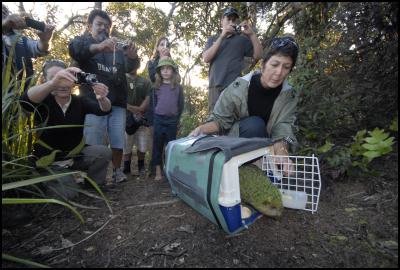
The transfer of seven critically endangered kakapo to Little Barrier Island is a significant move to help secure the species’ survival, Conservation Minister Kate Wilkinson says.

The native parrots were captured on the predator-free Whenua Hou/Codfish Island and Anchor Island in Southland then airlifted – by helicopter and Air New Zealand passenger flights - to their new home north of Auckland yesterday.

Though the birds will be monitored by the Department of Conservation on Hauturu/Little Barrier Island, they will be free to breed and raise their chicks without the high level of support they currently receive.

“This is an epic journey by these flightless birds. They have been flown almost the length of the country in one day to a new home,” Ms Wilkinson says.

“The kakapo have been released on Little Barrier Island to see if they can successfully raise their chicks without aid. Their progress will be closely monitored and support will be provided if it’s required to keep the birds alive.

“There are only 126 kakapo left in the world and we need to see if they can survive and flourish without outside help. This initiative could play a major role in securing the long term survival of the species.

Kakapo lived on Hauturu/Little Barrier Island between 1982 and 1999, when they were moved so the island could be cleared of rats. It is expected to take up to 10 years to determine if the kakapo can bring up their chicks without assistance.

The work is part of the Kakapo Recovery Programme, a joint initiative between the Department of Conservation, New Zealand Aluminium Smelters and Forest & Bird that dates from 1990.

 “This is DOC’s longest-running conservation partnership and it’s been a great success. Since it was formed kakapo numbers have more than doubled.

“This partnership shows what can be achieved when the government, the private sector and the community work together toward a shared conservation goal.”

Background Information:

The kakapo or ‘night parrot’ is unique to New Zealand and was pushed toward extinction by human colonisation and the introduction of predators such as rats, stoats and possums. By 1995 only 50 kakapo were known to exist. Today there are 126 kakapo being managed by DOC on Whenua Hou/Codfish Island, near Stewart Island, and Anchor Island, in Fiordland.

The Kakapo Recovery Programme includes running breeding programmes, maintaining predator-proof sanctuaries and strengthening the wild kakapo population. It combines the efforts of scientists, rangers and volunteers. This work includes intensive monitoring of kakapo, regular health checks, predator control, supplementary feeding, artificial incubation and hand-rearing, research (ground breaking artificial insemination in birds, genetic studies, and supplementary feeding trials), and developing technology.

Eight kakapo were captured on Whenua Hou/Codfish Island and Anchor Island yesterday. One of the birds was found to have a minor injury and was taken to Auckland Zoo as a precaution.

Thursday, 8 March 2012

Search is on for NZ's last Kakapos


They are calling it the search for the last kakapo, according to Fairfax newspapers.

A Conservation Department (DOC) team flew to Fiordland - the endangered birds' last mainland stronghold - in the hope of finding evidence of their existence in historic breeding areas.

The trip was sparked by a credible-sounding report from trampers that the ground-dwelling parrot's distinctive "booming", or mating call, was heard in the remote Transit Valley, near Milford Sound, on New Year's Day.

If audio recorders left on the valley's rugged ridgelines pick up further booming, it will be the first confirmed sign of kakapo on mainland New Zealand for decades.

Kakapo Recovery Programme manager Deidre Vercoe Scott said the mission was a long shot, but the discovery of new birds would be significant for the population's recovery.

Once threatened with extinction by stoats, ferrets, weasels and cats, the kakapo is now threatened by poor genetics.

All but three of the remaining 126 birds, living on two predator-free islands, originate solely from Stewart Island stock.

Scientists believe that genetic bottleneck has led to complications with the breeding programme, including high levels of infertility and embryo death.

Concerns about poor genetics has prompted DOC to consider removing one bird, Basil, from the breeding programme after the death of four of his young progeny since 2004, including one young male that died last week.

Southland-based DOC technical support manager Andy Cox, whose first kakapo-related trip to the Transit Valley was in 1976, said finding birds with Fiordland DNA was potentially valuable.

"This report sounds particularly hopeful and we've just got to keep our fingers crossed," he said.

Kakapo can live for 90 years, and some Fiordland kakapo fitted with radio transmitters in the 1980s have never been found. A DOC-led search in Fiordland in 2006 proved fruitless.

Last week, Vercoe Scott's team spent four nights camped on the eastern side of Transit Valley in an area known as "kakapo castle". The trip was funded by the Christchurch-based Mohua Charitable Trust.

The team set up audio recorders and checked known breeding sites.

Vercoe Scott said there were no fresh signs of kakapo.

"I think it's quite unlikely that we'll discover anything this year, but we'll earmark that area for the next breeding season and return those recorders just to make sure," she said.

DOC intends to retrieve the recorders within two weeks.

The species seemed doomed until the discovery of about 200 kakapo on Stewart Island in 1977. However, numbers continued to drop, hitting a low of 51 in 1995.

Wednesday, 9 November 2011

Sirocco is one in 129 (Kakapos, that is)


He's one of the most popular birds in New Zealand, and as one of just 129 endangered Kakapos in existence, one of the few night parrots left, making him very special indeed.

Sirocco shot to international fame after getting frisky with British celebrity Stephen Fry and zoologist Mark Carwadine in the acclaimed TV series Last Chance to See in 2009. Sirocco found Carwadine's hair inexplicably attractive, prompting Fry to exclaim: "You are being shagged by a rare parrot!"

Bizarrely, bidders on Trade Me recently clamoured to buy a unique piece of Sirocco-related history - his rejected 'pine chews' being sold on the popular online auction site. The 'parrot puke' eventually fetched $400!

The posting stated: "Not to be found anywhere else on the Mainland - this is a truly unique item. Impress your friends. Perturb your mother in law. Made of tenderly masticated pine needle and infused with the saliva of an extremely rare native parrot - and not just any old rare native parrot but Sirocco the famous head shagging parrot!"

Well, there you go. It was all for a good cause though - the money will be used to fund kakapo recovery.

For those who can't meet Sirocco in the flesh and feathers, you can watch him on this video: