Saturday, 18 August 2012
Now that winter is finally starting to release its icy grip, and blossoms are starting to show on many of the trees work can begin on the myriad of plans contrived and pondered while huddled around the warmth of a fire.
One of the Plans that has been slowly chipped away at is the building of a butterfly house directly adjoining and incorporating the window of my study. How delightful it will be during the summer months to sit at my desk and watch the butterflies go about their business ready for release to increase the dwindling population that already exists in New Zealand. A project I am quite excited about.
Work continues on the book I am working on and surprisingly I'm quite enjoying it so it doesn't seem like a task at all but an absolute pleasure to research and learn new things.
I recently purchased a couple of very beautiful moths, papered so this is one project I'm quite nervous of as I had to go through the whole procedure and mount them, and believe me they are too beautiful to make a mess of. I can now understand Grahams dilemma of a few months ago.
We have plans currently on the boil to build some bumblebee shelters this summer as these little creatures are becoming rarer sight every year.
Another project is to build hedgehog wintering boxes in the hopes of improving their population as they too are also becoming rarer and rarer.
Another project we have decided to undertake at the New Zealand CFZ is we have obtained a Formicaria in which we first intend to raise some of the more household garden variety of ants. Eventually, after ironing out the problems we would like to have a go at raising some of the New Zealand native species hopefully to rerelease back into areas of native bush. Hopefully these releases will help replenish New Zealand's dwindling ant population.
It's amazing how the tend to concentrate on the larger creatures, and how endangered, unusual or just plain enigmatic they actually are and yet, there are just as many fascinating creatures at our feet and totally overlooked.
Excitingly, it is also that time of year again that whitebait make their way up river and very soon the banks will be lined with many fishermen dreaming of whitebait fritters.
Once again through a kind benefactor there will be some that will not reach the frying pan and allow me to continue my research into these fascinating fish.
Regrettably I was only able to get one to survive from last year's lot. As they are, from what I hear, extremely hard to rear I find that achievement in itself. When Sally, as we have called her putting young whitebait in with her would be a big mistake, so I shall raise them in a separate tank until they are big enough to stand up for themselves.
Lots of projects, lots of enthusiasm, and I must state all round so it looks like things may get a little exciting for awhile.

Thursday, 9 August 2012
OOPA: Moose photos from Canada, not NZ

Four photographs of three moose that a Northland man claimed last year were taken in Fiordland in 1953 were actually taken in Canada.
In June last year, the late Fred Stewardson, of Hikurangi, recounted to the Otago Daily Times and other media how he and a companion came across the animals on a hunting trip to Wet Jacket Arm.
However, Fiordland moose researcher Ken Tustin, of Bull Creek near Milton, said yesterday after two years of work he had established the photographs were taken near Banff in 1958.
Mr Tustin was uncertain of Mr Stewardson's motives but had found Mr Stewardson's life was "full of exaggerations".
"The old fellow was absolutely entranced by the moose story, knew or found out, through me, a bit about it, and then wrote himself into it."
Mr Tustin received final confirmation Mr Stewardson's story was false by speaking to his ex- wife in Australia, who clearly recalled where the moose photographs were taken.
Mr Tustin said he had spent hours speaking to Mr Stewardson by phone and had received letters from him supporting his story.
He now believes Mr Stewardson, who died nine months ago, never visited Wet Jacket Arm but was quite likely in Fiordland in 1952 when the head of a bull moose was brought out of the bush.
North American moose were released in Fiordland in 1910 and Mr Tustin has spent many years trying to establish that their descendants remain there.
Mr Stewardson claimed he kept the photographs a secret for 60 years to keep the Fiordland moose safe from other hunters.
"Fiordland will have loads of trigger-happy clowns there for slaughter.
Many won't give a damn if moose survive or not," he wrote to Mr Tustin last year.
Mr Tustin said he had early reservations about the photographs because of the shape of vegetation, but believed it did resemble vegetation he had seen in different parts of Fiordland.
After the photographs were published in the ODT he received an anonymous call warning him not to believe Mr Stewardson.
But despite offering Mr Stewardson the opportunity to retract his story, he never did.
"I'm disappointed he carried his story - knowing it was not true - to such great lengths ... knowing how important the accuracy of my [moose] history was to me."
Wednesday, 8 August 2012
THE MYSTERY FLY - SOLVED
After some time, on both the powers that be and my part due to a Mother very ill with Lung Cancer, I have finally received results regarding these flies.No they are not a new species and yes it is a fungal infection, But there was a new type of fungi as well which is interesting.The first type which i mentioned previously is a sort of Zombie Fungi as it invades the host including the brain and feeds from the inside out. In the process it takes over the brain and when ready to spawn encourages the fly to fin a high point suitable for distribution.Once this is done the fly literally stops in its tracks dead, and the fungi disperse infecting the next host.
Tuesday, 8 May 2012
[Enter Post Title Here]
Update On-The-Fly Situation:
I was hanging over the weekend so the specimen would not be lying and is on couriers office with a high likelihood of the damage. It's a good thing I did hang off as I've found another fly exactly the same as the first one. After doing some research it seems to me both these flies could be Chrysanthrax dispar.
Photo#124305
 Copyright © 2007 Scott Nelson
Unknown Small Bee Fly - Chrysanthrax dispar
Three Lakes Wilderness Area, Osceola County, Florida, USA
July 3, 2007
Size: 5 - 6 mm
tag • login or register to post comments
Contributed by Scott Nelson on 4 July, 2007 - 4:44pm
Last updated 29 August, 2009 - 11:54am
I don't know whether these are endemic to New Zealand or have somehow passed border control, we have a shipping port not very far from us. It will be interesting to see what the answer the Department of conservation come up with.
I am hoping to get this specimen away tomorrow, so now it is just a matter of time.
Copyright © 2007 Scott Nelson
Unknown Small Bee Fly - Chrysanthrax dispar
Three Lakes Wilderness Area, Osceola County, Florida, USA
July 3, 2007
Size: 5 - 6 mm
tag • login or register to post comments
Contributed by Scott Nelson on 4 July, 2007 - 4:44pm
Last updated 29 August, 2009 - 11:54am
I don't know whether these are endemic to New Zealand or have somehow passed border control, we have a shipping port not very far from us. It will be interesting to see what the answer the Department of conservation come up with.
I am hoping to get this specimen away tomorrow, so now it is just a matter of time.

That dang fly again – nand then there were two.
I was hanging over the weekend so the specimen would not be lying and is on couriers office with a high likelihood of the damage. It's a good thing I did hang off as I've found another fly exactly the same as the first one. After doing some research it seems to me both these flies could be Chrysanthrax dispar.
Photo#124305
Copyright © 2007 Scott Nelson
Unknown Small Bee Fly - Chrysanthrax dispar
Three Lakes Wilderness Area, Osceola County, Florida, USA
July 3, 2007
Size: 5 - 6 mm
tag • login or register to post comments
Contributed by Scott Nelson on 4 July, 2007 - 4:44pm
Last updated 29 August, 2009 - 11:54am
I don't know whether these are endemic to New Zealand or have somehow passed border control, we have a shipping port not very far from us. It will be interesting to see what the answer the Department of conservation come up with.
I am hoping to get this specimen away tomorrow, so now it is just a matter of time.
Thursday, 3 May 2012
It just goes to show even amateurs can still make scientific contributions
.
The other day I had just taken a break and on returning to my desk found a house fly sitting on my mouse as if still alive. The creature however did not seem alarmed by my reappearance so I became curious and examined it more intimately.
It was most decidedly dead but the unusual thing was I had never seen a fly like it. The front end was that of a normal house fly, but the abdomen was entirely different it was striped black and white in a not unattractive manner. The wings also appeared shorter than the ordinary house fly.
 I decided this justified further investigating and put the specimen under the microscope for a more detailed view . The stripes were unquestionably part of the thorax, although the poor beast had some kind of fungal infection , which had obviously infiltrated its whole-body, as threads were sticking out between in the abdominal platelets, the white nevertheless showed as platelets themselves.
 Not having adequate knowledge in this field I contacted an entomologist with the Department of Conservation, David Voice, On scrutiny of the photographs he said it would take a while for them to get back to me.
The following day I received an e-mail from Mr Voice indicating that this fly did express some anomalousness and could I please dispatch it to his department for further scrutiny and analysis.
The specimen is now what I hopefully is packed in a safe and protected manner and ready to send to Mr Voice for further recognition and analysis.
As any results come through I will keep the blog updated.
Not having adequate knowledge in this field I contacted an entomologist with the Department of Conservation, David Voice, On scrutiny of the photographs he said it would take a while for them to get back to me.
The following day I received an e-mail from Mr Voice indicating that this fly did express some anomalousness and could I please dispatch it to his department for further scrutiny and analysis.
The specimen is now what I hopefully is packed in a safe and protected manner and ready to send to Mr Voice for further recognition and analysis.
As any results come through I will keep the blog updated.


Monday, 16 April 2012
Flight of a Kakapos key to survival
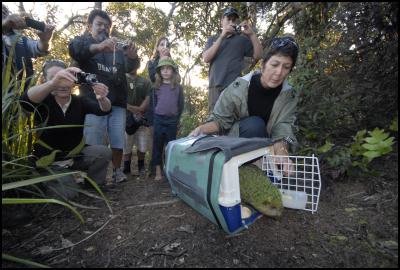
The transfer of seven critically endangered kakapo to Little Barrier Island is a significant move to help secure the species’ survival, Conservation Minister Kate Wilkinson says.
The native parrots were captured on the predator-free Whenua Hou/Codfish Island and Anchor Island in Southland then airlifted – by helicopter and Air New Zealand passenger flights - to their new home north of Auckland yesterday.
Though the birds will be monitored by the Department of Conservation on Hauturu/Little Barrier Island, they will be free to breed and raise their chicks without the high level of support they currently receive.
“This is an epic journey by these flightless birds. They have been flown almost the length of the country in one day to a new home,” Ms Wilkinson says.
“The kakapo have been released on Little Barrier Island to see if they can successfully raise their chicks without aid. Their progress will be closely monitored and support will be provided if it’s required to keep the birds alive.
“There are only 126 kakapo left in the world and we need to see if they can survive and flourish without outside help. This initiative could play a major role in securing the long term survival of the species.
Kakapo lived on Hauturu/Little Barrier Island between 1982 and 1999, when they were moved so the island could be cleared of rats. It is expected to take up to 10 years to determine if the kakapo can bring up their chicks without assistance.
The work is part of the Kakapo Recovery Programme, a joint initiative between the Department of Conservation, New Zealand Aluminium Smelters and Forest & Bird that dates from 1990.
“This is DOC’s longest-running conservation partnership and it’s been a great success. Since it was formed kakapo numbers have more than doubled.
“This partnership shows what can be achieved when the government, the private sector and the community work together toward a shared conservation goal.”
Background Information:
The kakapo or ‘night parrot’ is unique to New Zealand and was pushed toward extinction by human colonisation and the introduction of predators such as rats, stoats and possums. By 1995 only 50 kakapo were known to exist. Today there are 126 kakapo being managed by DOC on Whenua Hou/Codfish Island, near Stewart Island, and Anchor Island, in Fiordland.
The Kakapo Recovery Programme includes running breeding programmes, maintaining predator-proof sanctuaries and strengthening the wild kakapo population. It combines the efforts of scientists, rangers and volunteers. This work includes intensive monitoring of kakapo, regular health checks, predator control, supplementary feeding, artificial incubation and hand-rearing, research (ground breaking artificial insemination in birds, genetic studies, and supplementary feeding trials), and developing technology.
Eight kakapo were captured on Whenua Hou/Codfish Island and Anchor Island yesterday. One of the birds was found to have a minor injury and was taken to Auckland Zoo as a precaution.
Subscribe to:
Posts (Atom)